You’re halfway down the stairs when the question hits: “Did I lock the door?”
Your bag feels lighter than it should, your keys might be on the kitchen counter, and your brain is suddenly replaying the last five minutes like low-budget security footage.
You pause, scroll your mental checklist, and realize… there is no checklist. Just vague panic and a bus you’re about to miss.
We’ve all been there, that moment when your body is outside but your mind is still in the hallway.
There is a much easier way to leave home without that tiny heart attack.
And it starts before you touch the doorknob.
The real reason you keep forgetting things at the door
Most of us blame “bad memory” when we walk out without keys, badge, or headphones.
The truth is more mundane: our leaving-the-house routine is pure chaos.
You’re checking messages, zipping a coat, maybe answering a child from another room.
Your brain is juggling micro-tasks, none of which feel important on their own.
Then the door closes with a final, confident click.
Only when you reach the elevator does your mind finally have room to realize: the wallet is still on the table.
A London commuter once strapped a tile tracker to his keys after missing a train three Mondays in a row.
Not because he lost them in the city, but because he kept leaving them in the same bowl by the sink.
He started timing his mornings.
Those frantic last three minutes before leaving were a cocktail of half-finished actions: coffee sips, sock hunting, headphone untangling, weather-checking.
In a small survey by a French insurance company, nearly 40% of respondents admitted returning home at least once a month for something forgotten.
Not dramatic things.
Just “everyday essentials” that quietly dictate whether the day runs smooth or feels like a series of small avoidable annoyances.
➡️ This profession pays modestly at first but becomes extremely lucrative over time
➡️ “I finally understood why my budget failed when I crossed the $50,000 income mark”
➡️ I changed the way I end my day and cleaning became easier
➡️ This natural fertilizer works slowly but strengthens plants from the roots up
➡️ This baked dinner delivers warmth more than excitement
➡️ This is why some interactions feel emotionally heavy
➡️ I made this comforting recipe with leftovers and it still tasted incredible
➡️ “I work as a technical coordinator and make $68,400 a year”
Our memory isn’t designed for stressed, multi-tasked exits.
It’s designed for patterns.
When there is no fixed pattern to leaving home, the brain treats each departure like a new situation.
Some days you take a laptop, some days you don’t. Some days you need gym clothes, some days you’re just going downstairs for bread.
That’s why the classic mental mantra — “keys, wallet, phone” — fails the moment your day slightly changes.
Your mind needs a simple, repeatable ritual that doesn’t depend on willpower.
*The easiest way to remember what you need when leaving home is to stop relying on memory at the door.*
The one tiny ritual that changes everything
The easiest method isn’t an app or a gadget.
It’s a “launchpad”.
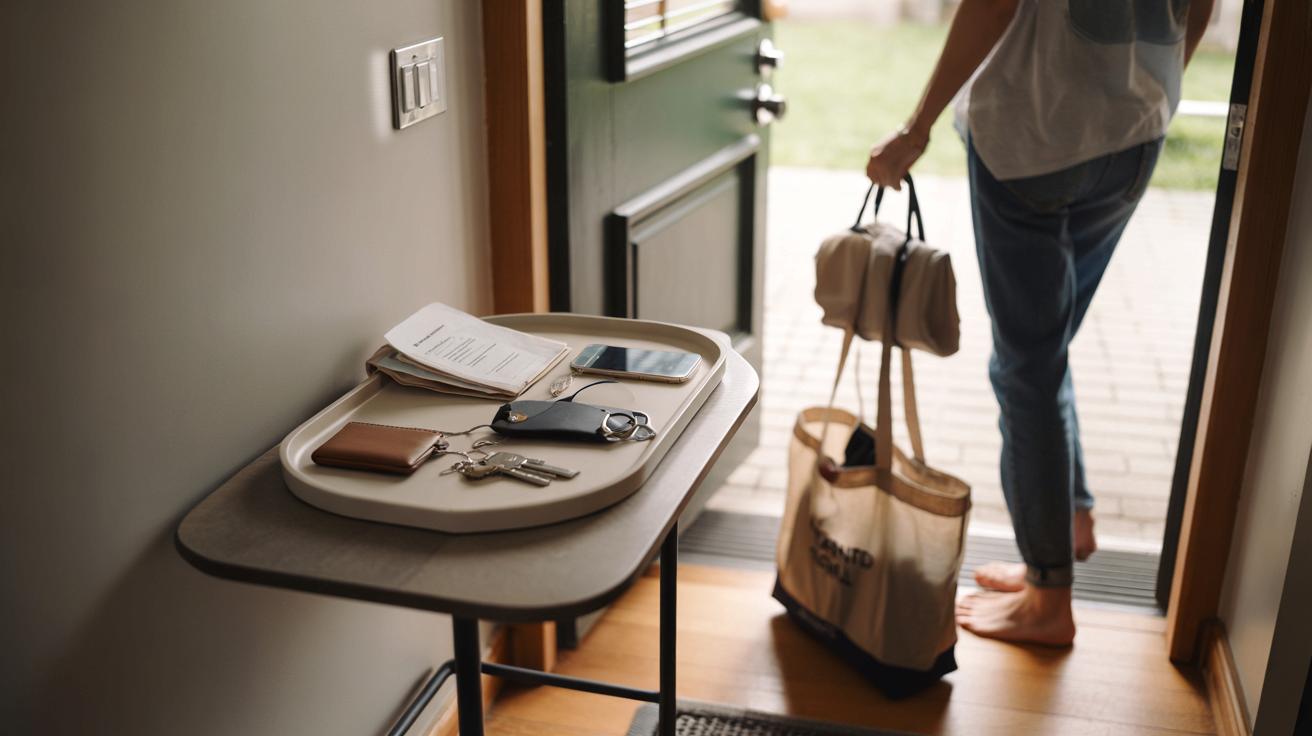
Pick a single visible spot, as close as possible to the door: a small shelf, a tray, a shallow box, even a big plate.
That’s where anything that must leave with you lives.
Not somewhere “logical”.
Somewhere unavoidable.
Every evening or right when you come home, drop your keys, wallet, phone, badge, and tomorrow’s non-negotiables on that launchpad.
Your departure stops being a hunt.
It becomes a quick sweep over one small, familiar island.
Picture this.
You get home, tired, juggling groceries and a backpack.
Without thinking, you pass by your launchpad: keys down, transport card down, headphones down.
The receipt with tomorrow’s appointment slips there too.
Later that night, you remember you need to bring a document to the office.
You don’t tell yourself “I’ll remember in the morning”.
You stand up, walk to the launchpad, and place the document on top of your keys.
Morning comes.
Eyes still half-shut, you walk to that same spot and everything you need is already silently waiting in one frame.
This works because you move the mental work from the last minute to earlier moments with less pressure.
Your brain loves clear locations tied to a single purpose.
The launchpad becomes a physical checklist.
If it’s not there, it’s not leaving.
You’re no longer scanning your whole apartment, just that small square meter.
The stress fades because the system is external, visible, and repetitive.
Let’s be honest: nobody really does this every single day with military discipline.
Yet the days you do, the difference is so obvious that you start defaulting to it almost without thinking.
How to make your “launchpad” foolproof
To turn this into an almost-automatic reflex, link the launchpad to actions you already do.
For example: “Keys on tray the second the door closes.”
Or “Phone and wallet on tray right after I drop my bag.”
Always in the same order, always in the same spot.
You can even speak it out softly as you do it: “Keys, phone, wallet, badge.”
It sounds a bit silly alone in the hallway, yet that whisper locks the gesture into your routine.
The crucial part is: don’t wait for the morning.
Tomorrow’s stuff goes to the launchpad today, while you still have energy and time to walk back to the bedroom if needed.
A frequent mistake is turning the launchpad into a mini-dump.
Receipts, random pens, coins, sunglasses from three summers ago.
Once the place looks messy, your brain stops seeing it as a signal and starts seeing clutter.
So keep it visually clean and limited.
Another trap is trying to overhaul your whole life at once.
You don’t need a color-coded wall organizer.
Start with three non-negotiables only: **keys, wallet, phone**.
When that feels automatic, add your work badge or earphones, then maybe your reusable bag.
If you skip a day, don’t beat yourself up or declare the system “broken”.
Just restart the next time you walk in.
The launchpad isn’t a contract; it’s a small kindness to your future self.
“I stopped forgetting my work badge the day I decided it was not allowed to live anywhere else than that little bowl by the door,” laughs Julie, a nurse who leaves home at 5:30 a.m. most days. “If it’s not in the bowl at night, I get up and go find it. Morning Julie always thanks Evening Julie.”
- Keep it tiny
A small surface forces you to keep only the essentials, so your eyes instantly catch what’s missing. - Keep it visible
Place it where you literally can’t open the door without seeing it, not hidden behind a coat rack. - Keep it boring
No decoration overload. A neutral tray, a simple hook, a box with one clear purpose works better than a stylish but chaotic console. - Keep it shared
If you live with others, agree that this is the sacred “exit zone”. Kids pick it up fast when they see adults using it daily. - Keep it honest
If an item never lands there, ask yourself if you truly need it daily or if it’s aspirational clutter.
When leaving home feels lighter again
Something subtle shifts when your departure stops being a small daily drama.
You close the door, feel the keys in your hand, and your brain doesn’t launch into a doubt spiral.
You walk towards the bus, or your bike, or the car, with a quiet sense that today is not starting with a stupid, preventable mistake.
That doesn’t mean life becomes perfectly organized.
You will still have days when the umbrella stays home under a blue sky that turns black.
Yet that core trio — keys, wallet, phone — is covered.
And most days, the extra things you placed on the launchpad the night before come along too, almost like you had a silent assistant at the door.
You might adapt this method to your own rhythms.
Some will stick Post-its above the launchpad: “Laptop charger”, “Lunch box”, “Gym pass on Tuesdays”.
Others pair it with a quick glance at a weekly checklist on the wall.
The shape doesn’t matter as much as the gesture: move the decision from panic-time to calm-time.
What happens next is interesting.
Once the exit ritual is stable, your mind has room for something other than “What have I forgotten?”.
A line of a song.
A thought about your day.
Or just the quiet enjoyment of closing your door, knowing that what you need is already with you.
That small sense of control often spreads to the rest of your routine without you even naming it.
| Key point | Detail | Value for the reader |
|---|---|---|
| Create a launchpad | One visible spot near the door that hosts all essentials | Reduces last-minute stress and forgotten items |
| Shift decisions to the evening | Place tomorrow’s must-haves on the launchpad in advance | Mornings feel smoother, even when you’re tired or rushed |
| Keep a simple ritual | Repeat the same small gesture and phrase every time you get home | Turns memory into habit, without needing constant effort |
FAQ:
- Question 1What if my hallway is tiny and I have almost no space?
- Answer 1Use a wall hook, a narrow key rail, or a small adhesive shelf. The launchpad can be vertical. The goal is “one fixed place”, not “a big piece of furniture”.
- Question 2How long does it take for this habit to feel natural?
- Answer 2For many people, around two to three weeks of semi-regular use. You’ll notice it works the first day you leave without that familiar wave of doubt at the door.
- Question 3Can I just use a digital checklist on my phone instead?
- Answer 3You can, but digital lists still rely on you remembering to open them. A physical launchpad stares at you when you reach for the handle, which is exactly when you need the reminder.
- Question 4What about items I only need sometimes, like gym clothes?
- Answer 4Link them to specific days or triggers. For example, on gym days, your sports bag lives on the launchpad the night before. If it’s not there, you’re not “gym ready”.
- Question 5Isn’t this just being a bit obsessive?
- Answer 5Not really. It’s about reducing mental load, not controlling everything. A two-second habit that saves you from ten minutes of chaos, or a missed bus, is usually a fair trade.