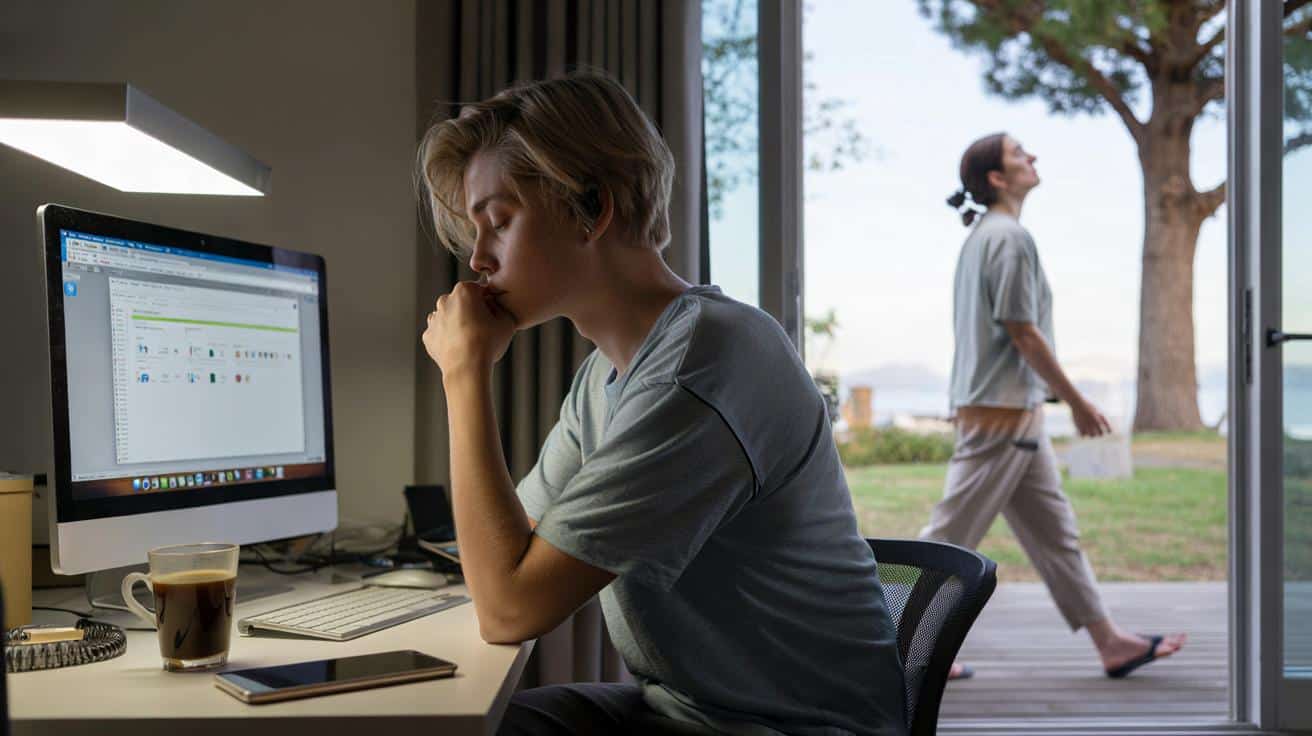
On a Tuesday that already felt like a Thursday, I caught myself staring at the progress bar of a file that refused to upload. My shoulders were glued to my ears, coffee was cooling beside the keyboard, and my brain felt like someone had quietly swapped it for wet cardboard. So I did what everyone says to do: I took a break. I walked to the kitchen, scrolled my phone, refilled my mug, came back. Ten minutes gone. Nothing really changed. The fatigue was still there, just slightly better caffeinated.
After months of this, something uncomfortable clicked: the problem wasn’t that I didn’t take breaks. It was the way I took them.
That small realization shifted everything.
The day I realized “taking a break” wasn’t actually a break
We’ve all been there, that moment when you slam the laptop shut and announce to nobody, “I need a break,” then open TikTok before your chair has even stopped spinning. You scroll, half-laugh at a video, glance at the time, and rush back to work feeling… oddly the same. Slightly more distracted. Slightly more tired. Definitely not refreshed.
For a long time, I thought this was normal. This was just what breaks were now. Quick hits of content between tasks, a gulp of coffee, a micro-escape. My brain felt like a browser with 47 tabs open, and my “rest” was just opening three more.
One afternoon, a colleague sent a single line in our chat: “Try resting your brain, not just your body.” It annoyed me, mostly because it sounded like something from a productivity poster. But later that day, stuck on a headline and too mentally fried to fake it, I tried something different. No phone, no laptop, no podcasts. I just went outside, walked once around the block, and looked at actual trees instead of the green focus-dot on video calls.
Those ten minutes felt weird. Empty. My fingers twitched for my phone. And yet when I sat back down, the headline came in thirty seconds. That had not happened in weeks.
The next few days turned into an experiment. Same workload, same deadlines, new rule: breaks had to be “input-free”. No screens. No notifications. No sneaky email checks “just while the kettle boils.” What changed surprised me. My afternoon headaches shrank. I made fewer stupid mistakes. Work that normally dragged for an hour took forty minutes. It wasn’t magic. It was simply that my breaks were finally doing the one job they were meant to do: letting my attention reset.
*I thought breaks were a time to escape work; they turned out to be a way to rebuild attention.*
The simple habit that made breaks actually work
The habit that changed everything was embarrassingly small: I decided that every real break had to be tech-free and single-purpose. No “just checking messages,” no “I’ll put on a quick video.” If I was resting, I was resting. If I was moving, I was moving. Five to ten minutes, one action. That was it.
➡️ If your home feels crowded, this placement change helps
➡️ This baked recipe proves that simple cooking can still feel special
➡️ This simple habit helps you reset between busy moments
➡️ The common cause of low energy that has nothing to do with diet
➡️ “I work as a technical coordinator and make $68,400 a year”
➡️ This profession pays modestly at first but becomes extremely lucrative over time
➡️ This natural fertilizer works slowly but strengthens plants from the roots up
➡️ The subtle impact of background noise on mental energy
Sometimes that meant staring out the window like a confused cat. Sometimes it was stretching my back against the wall. Sometimes it was rinsing a few dishes, just to move my hands in a different way. The rule was simple: nothing that pulled me into another stream of information.
At first, I kept forgetting. My muscle memory was wired to grab the phone whenever I stood up. So I started placing it face down, out of reach, during intense work blocks. On my first proper tech-free break, I walked down the stairs of my building and sat on the steps. No earbuds. No doomscrolling. Just people, traffic, the quiet drama of city life. I remember noticing how tight my jaw was. By the time I climbed back up, the article I’d been wrestling with didn’t feel like a wall anymore. It felt like a door I could actually open.
Let’s be honest: nobody really does this every single day.
Why does this tiny habit hit so hard? Because most “breaks” we take are just swapping one kind of stimulation for another. Our brain never gets the downtime it needs to file information, reset working memory, and calm the stress chemicals buzzing around. When you remove digital input, your attention isn’t constantly yanked sideways. There’s room for boredom, and boredom is strangely powerful. That’s often when the brain starts quietly solving problems in the background.
By making breaks tech-free by default, they go from being mini-distractions to mini-recoveries. **Same minutes, completely different impact.**
How to turn your breaks into real recovery time
The most practical way to start is with a tiny structure: 45–50 minutes of focused work, then 5–10 minutes of real rest. Set a timer if you need to. When the timer rings, physically step away from where you’re working. Change posture, change location, change the view.
Then apply the habit: pick one simple activity, no screens allowed. Stretch your arms up and roll your shoulders. Walk to the end of the hallway. Water a plant. Look out of a window and find three things you hadn’t noticed before. The goal isn’t to “optimize” your break. It’s to give your brain a short, clear space with nothing it has to process.
If this sounds too easy, that’s exactly the trap. Many of us secretly feel guilty when a break looks like “doing nothing,” so we stuff it with content. A quick podcast. Two reels. Three notifications. We come back overloaded, not restored. There’s also the other extreme: waiting to take a break until you’re exhausted, snapping at emails, and rereading the same line five times. At that point, even a long pause can feel useless because you’ve already slid into depletion.
The sweet spot is small, regular, almost boring breaks that arrive before you’re cooked, not after.
“Rest isn’t the opposite of productivity. It’s the fuel that quietly keeps it going.”
— from my notebook after one very long week
- Keep it tech-free
No scrolling, no “quick checks.” Reduce input so your mind can reset. - Move your body a little
Stand, stretch, walk, or shake out your hands. Gentle movement unclogs mental fog. - Create a simple ritual
Same mug of tea, same short walk, same song you hum. A ritual tells your brain, “It’s safe to release for a minute.” - Break before you crash
Take a pause when you first notice tension or slipping focus, not when you’re fully drained. - Return with one tiny next step
Come back to your desk and decide on just the next 5-minute action. Momentum builds from there.
When breaks finally feel like breaks again
Something subtle shifts once you experience what a real break does to your day. The afternoons feel less like a battle against your own brain. You start noticing that on days with consistent, tech-free pauses, you’re less irritable in meetings, more patient with your kids, less drawn to late-night procrastination. Your energy doesn’t spike and crash as hard.
You also start seeing how much of your so-called “rest” is just more noise. The TV running in the background while you scroll. The reflex to open your phone at every red light. The urge to fill every quiet second with something.
This isn’t about living like a monk or deleting all your apps. It’s about stealing back a few honest minutes of emptiness in a day that’s otherwise full to the brim. Micro-moments where your brain is allowed to be offline, even if the world isn’t. You may find that your best ideas don’t show up when you’re grinding, but when you’re rinsing a cup, sitting on a bench, staring at the ceiling for no reason at all.
**The work doesn’t become easier. You just stop doing it with a brain that’s permanently running on fumes.**
| Key point | Detail | Value for the reader |
|---|---|---|
| Tech-free breaks | Short pauses with no screens or digital input | Deeper mental reset and less cognitive overload |
| Small, regular pauses | 5–10 minutes every 45–50 minutes of focus | More stable energy and fewer afternoon crashes |
| Single-purpose rest | One simple action per break: walk, stretch, gaze outside | Clearer attention and quicker return to productive work |
FAQ:
- How long should a real break last?For most people, 5–10 minutes every 45–60 minutes of focus works well. Longer pauses are helpful after big tasks or intense meetings.
- Is it okay to use my phone during breaks sometimes?Of course. The idea isn’t perfection, it’s balance. Try making at least every second or third break completely tech-free and notice the difference.
- What if I feel restless doing “nothing” on a break?That restlessness is normal at first. Choose a light activity like walking, stretching, or making tea so your body has something to do while your mind unwinds.
- Can this habit help with burnout?It won’t fix deep burnout by itself, but it can reduce daily overload and slow the slide toward it. Think of it as maintenance, not a cure-all.
- How do I stick to this when my job is nonstop?Start tiny: two or three tech-free breaks a day, even just three minutes each. Protect them like meetings. Small consistency beats big changes you can’t sustain.